Synchronicity
Content warning: Contains minor amounts of cartoony blood.
If you guess the hidden ace ♠️♦️♣️♥️, will you really guess right with 1/4 = 0.25 probability?
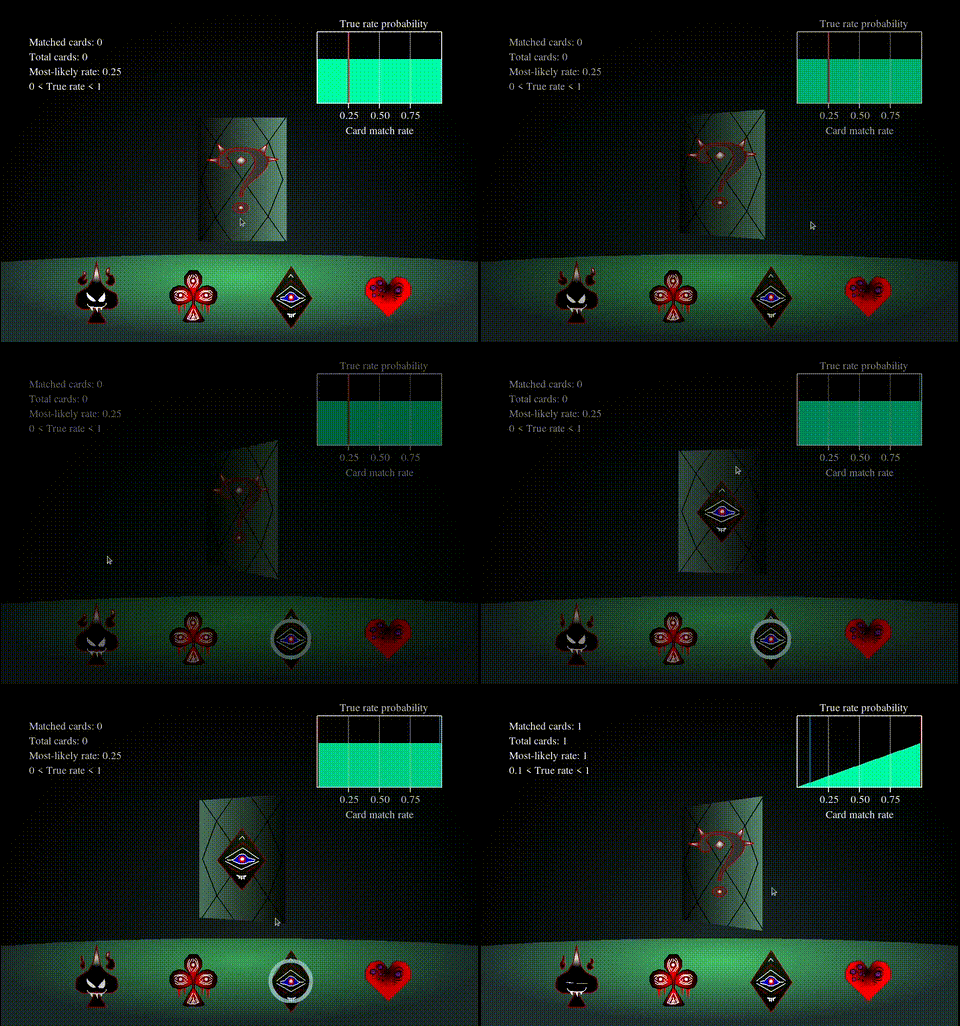
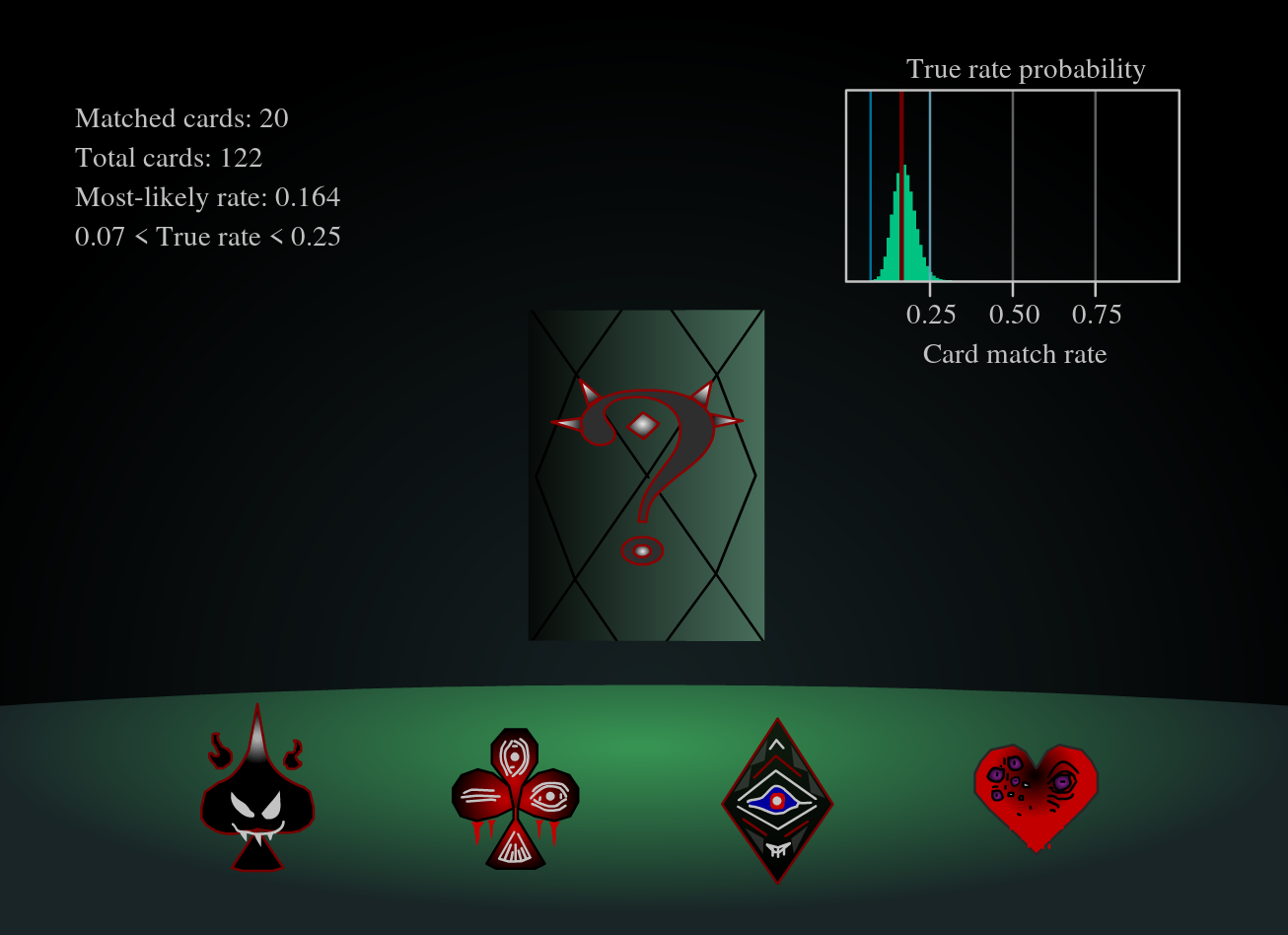
The game is simple: make your selection at the bottom, then click and drag your mouse to flip over the card in the middle to reveal the answer. Your true rate of correct answers is displayed in the upper-right window (detailed description below).
In 1952, Swiss psychologist Carl Gustav Jung published his book Synchronicity: An Acausal Connecting Principle in which he presented an analysis of a series of studies on card prediction to illustrate aspects of the phenomenon of synchronicity. Now it's your turn to try and predict which ace is the hidden card.
This game can be played in two ways: try to predict the hidden card, or try to avoid matching the hidden card (my personal preference).
Full explanation:
Many people have tried their go at card prediction, maybe with a friend, or maybe with Neil Patrick Harris before enlisting as a marine to fight the bug hordes of Klendathu, but even if you've managed to predict 5 cards in a row, there is often a little voice in us that says "could I actually tell, or did that happen by chance?"
So then how likely is such an outcome? In this particular case, the answer is about 1/1000, so bravo if you've ever managed that. In general, the probability that your true rate of card prediction can be determined through Bayesian analysis (result shown in the top right panel). If the predictions are truly "by chance," this rate should be 1/4. Your most-likely true rate is shown on the left (also shown as a red line in the right panel) just above the 99% confidence interval for your true rate (also shown as blue lines in the right panel).
Technical note on how many cards to predict (how much is enough?): So when can you be reasonably certain that your true rate deviates from the "chance" rate of 1/4? That all depends on how much your true rate differs from 1/4 or 0.25. If your true rate is 0.20, assuming you're going for avoiding the hidden card, then you'll need about 144 trials, one trial being one attempted prediction. What about 0.225? Then you'll need about 729 trials... So it all depends on how strongly your true rate deviates from 0.25.
If you're wondering where these numbers come from, feel free ask in the comments! I'd be happy to answer 😊
Please post your most striking deviation from 1/4 as your "Matched cards" and "Total cards" (and anything else you'd like to include) in the comments section whether you manage to get your true rate much higher or much lower than this number. I would love to see the results!
Good luck!
Leave a comment
Log in with itch.io to leave a comment.